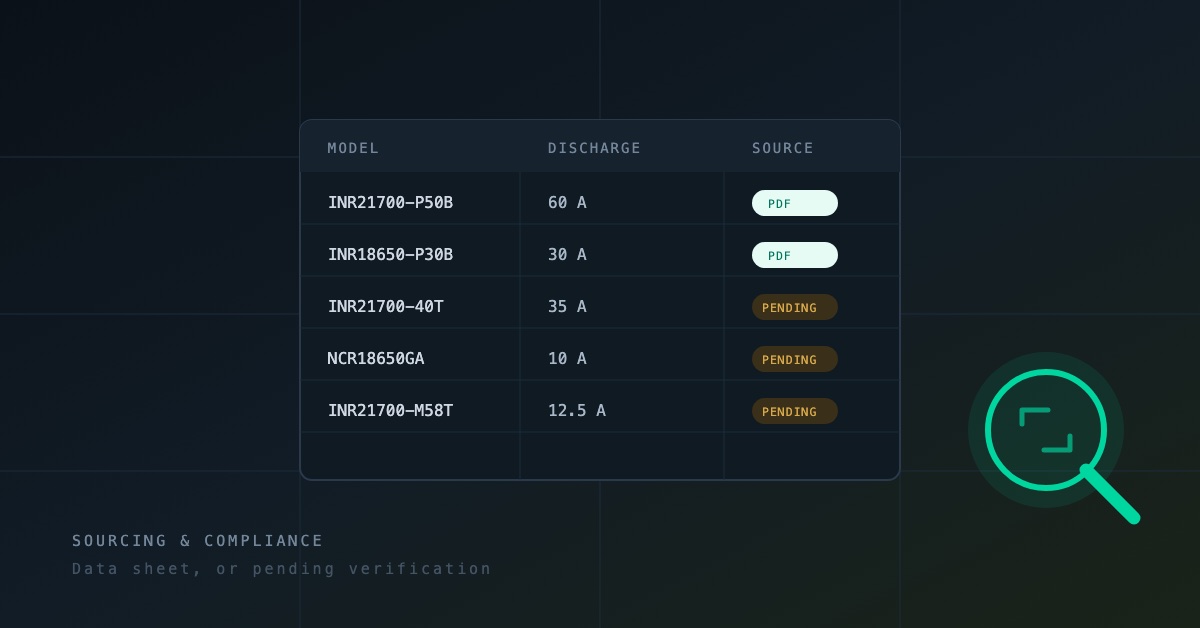
The Molicel INR18650-P30B is advertised with a maximum discharge of 36 A. The manufacturer's own data sheet v1.0 lists continuous discharge as 30 A, with an 80 °C cut-off. Both numbers are real; they are not the same number, and only one of them is the figure you can design a pack around.
Where the two numbers come from
| Figure | Source | Condition stated |
|---|---|---|
| 36 A | Manufacturer product page, marketing copy | none — quoted as "maximum" |
| 30 A | Manufacturer product data sheet v1.0, continuous discharge row | 80 °C cut-off |
The gap is not an error, it is a different question. A marketing maximum describes what the cell can be pushed to; the continuous row on the data sheet describes what it can sustain with a defined temperature limit and a defined end-of-discharge voltage. When a pack designer asks "how much current can I draw for the whole duty cycle", the second number is the answer and the first one is not.
Why the cut-off condition is doing the work
"30 A (80 °C cut-off)" means the rating holds as long as cell temperature stays at or below 80 °C, measured under the manufacturer's own test method. Take away the condition and you have a number that can be printed in a larger typeface and applied to any enclosure, any duty cycle and any ambient. The condition is the part that makes the rating transferable to your design; the number alone is not.
The same pattern appears elsewhere in this catalogue. The P50S is listed at 60 A standard and 100 A maximum, both with an 83 °C cut-off. The P22S is listed at 36 A with both the cut-off temperature and the end voltage stated. Where a document gives two conditions, we print both — stripping them to make a table look tidy is how a 36 A marketing figure ends up in a bill of materials.
How to check a figure yourself
- Open the manufacturer's PDF, not a reseller's specification table.
- Find the row labelled continuous or maximum continuous discharge. "Maximum" without "continuous" is usually the marketing figure.
- Read the condition printed next to it — cut-off temperature, end-of-discharge voltage, or duty cycle.
- Note the document version. Revisions move these numbers.
- If the document and the shop page disagree, ask the supplier which one they are quoting against.
Step 5 is where most of these get resolved. A supplier who answers "the data sheet" and can name the version is a different proposition from one who answers "the listing".
What it changes in practice
If your pack draws 25 A peak and the cell is rated 30 A continuous with a documented cut-off, the design has a margin you can describe in a safety file. If the same pack is justified against 36 A because a page said so, the margin is imaginary and the thermal justification does not exist. That is the whole consequence, and it is why this site quotes the data sheet figure and keeps the marketing figure as a note rather than a specification.
The P30B page carries both numbers with their sources: Molicel INR18650-P30B. The wider set of power cells is grouped on the high drain cells page, where every discharge figure is quoted with its cut-off condition for the same reason.
Last updated: October 2026