Cells welded into a series string should be matched on three things before the first weld goes down: capacity, impedance and open-circuit voltage. Matching is not about finding identical cells — it is about keeping the spread small enough that the weakest cell in the string does not define the pack, and that no cell is pushed outside its window by its neighbours.
The three values to sort on
| Value | Why it matters | What the spread does |
|---|---|---|
| Capacity | Sets the usable energy of the string; the lowest cell in a series string reaches empty first. | A 3% capacity spread costs you roughly 3% of usable energy and makes end-of-discharge detection unreliable. |
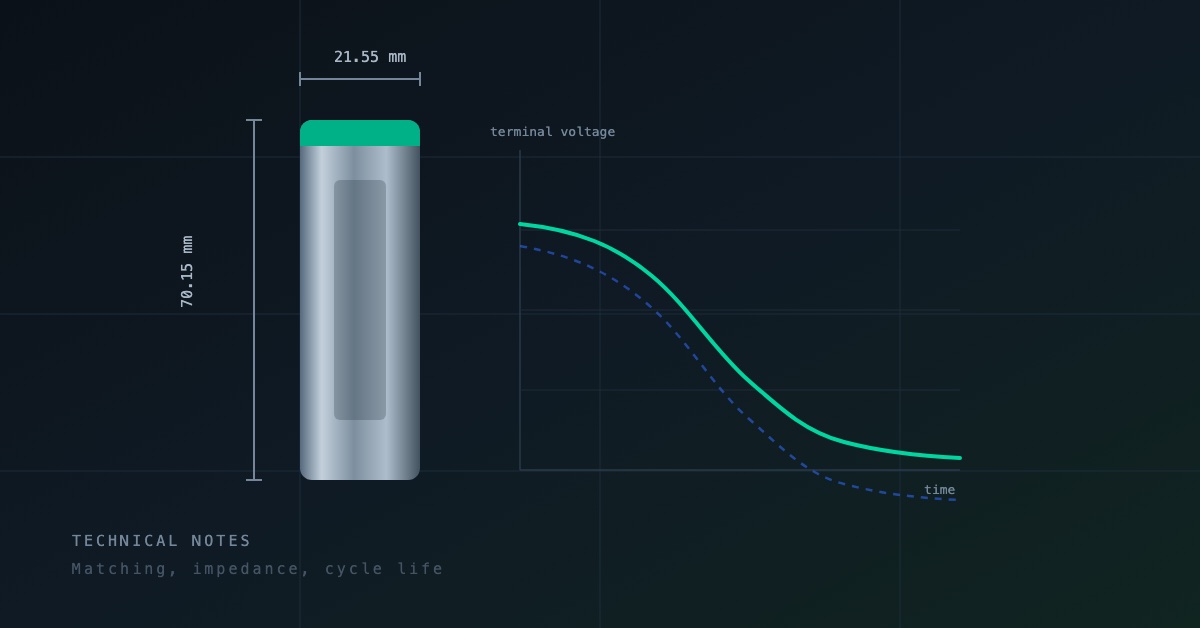
| Impedance | Sets how much the cell sags under load and how much heat it makes doing it. | An impedance outlier runs hotter, ages faster, and drifts further out of balance each cycle. |
| Open-circuit voltage | Proxy for state of charge at assembly; determines how much balancing the BMS has to do on day one. | Large initial spread means long first balance, or a BMS that never catches up. |
Read the impedance measurement condition first
Impedance is the value most often compared wrongly, because two manufacturers can publish the same unit for different measurements. AC impedance is measured at 1 kHz and is largely the cell's ohmic resistance; DC impedance is measured with a current pulse over a defined time and includes polarisation. They are not interchangeable, and a DC figure will always be larger than an AC figure for the same cell.
The condition printed next to the number is part of the number. Two examples from documents we hold:
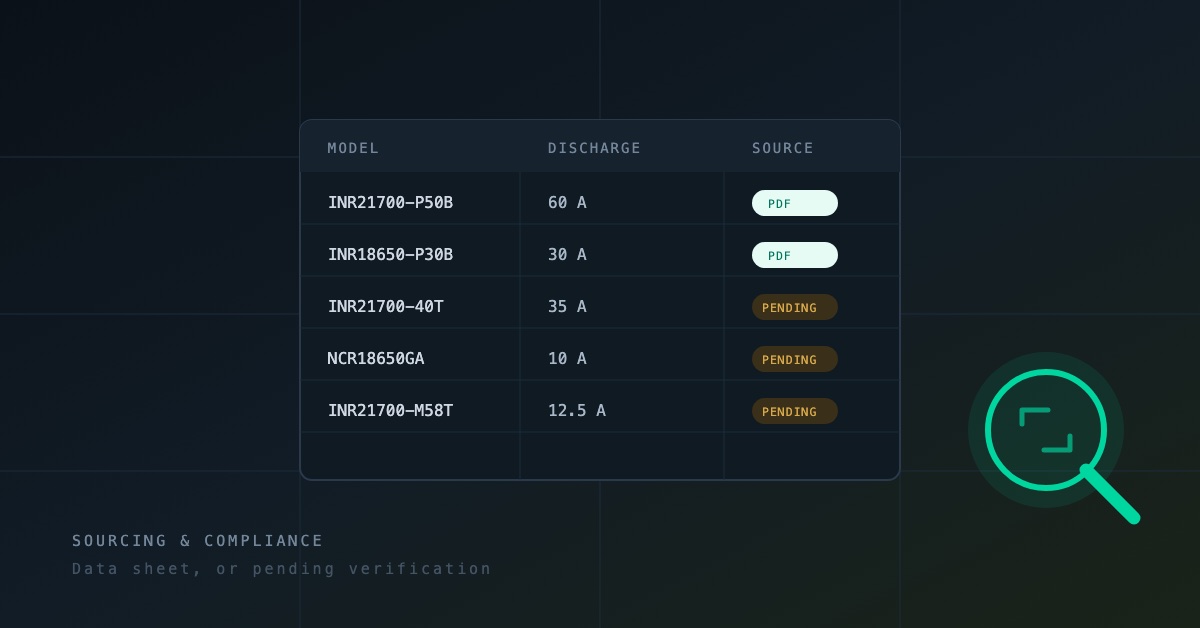
- INR21700-P50B — AC impedance 6.5 mΩ at 30% SOC, DC impedance 12.8 mΩ at 50% SOC.
- INR21700-P42A — AC impedance 10 mΩ at 1 kHz, DC impedance 16 mΩ measured at 10 A for 1 s.
Both are 21700 power cells, and the AC figures differ by half again. That is a real difference between the cells, not a measurement artefact — but you can only say that because both are AC figures. Comparing the P50B's 6.5 mΩ AC against a DC figure from another brand would produce a comparison that means nothing.
State of charge matters too. Impedance varies with SOC and temperature, so a matching measurement should be taken at a fixed SOC and a known temperature, on the same instrument, in the same session. Measuring half a batch in the morning and half after lunch is enough to put the spread in the measurement rather than in the cells.
A working procedure
- Record open-circuit voltage, capacity and impedance per cell at a fixed SOC and temperature before anything is welded.
- Sort by capacity first. Cells going into one string should come from the same capacity band.
- Within the band, reject impedance outliers rather than averaging them in. An outlier in a series string does not get better with cycling.
- Top-balance to a common voltage before assembly so the BMS starts from a small spread.
- Keep the record. When a pack underperforms in year three, the assembly record is the only way to tell a cell problem from a matching problem.
How much spread is acceptable
It depends on what the pack has to do. A stationary storage pack that cycles once a day to 80% depth of discharge can tolerate more spread than a drone pack that pulls most of its capacity in ten minutes, because the drone pack has no time for balancing and no thermal mass to absorb the outlier's heat. The application pages state the duty each one is specified against — stationary storage and e-mobility are at opposite ends of that range.
If you tell us the duty cycle and the pack format when you enquire, the matching requirement can be stated as a number instead of a rule of thumb. That is the difference between a quote that holds and one that gets renegotiated after the first batch.
Last updated: October 2026